


Product description
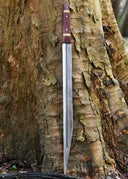
This seax is a replica of an example discovered in 1857 in the River Thames near London. It is now part of the collection of the British Museum.
The Seax of Beagnoth (also known as the Thames scramasax) is a 10th-century Anglo-Saxon seax. Several seaxes of a similar type are known from southern England (three from London, one from Suffolk, one from the River Thames near Keen Edge Ferry in Berkshire), and one from Hurbuck in County Durham in northern England. The seax from Berkshire is so similar in construction and design to the Seax of Beagnoth that both may have originated from the same workshop.
The blade of the seax is fully engraved with runes on one side. On the other side is the name Beagnoth, likely the smith or owner of the seax.
Runes were letters that also carried magical power. They were engraved on objects to give the wearer strength and protection. Runes could also be used for divination or making predictions.


