
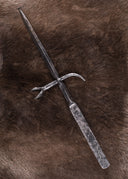


Product description
The Lucerne hammer is a poleaxe with a long shaft, a four-pointed hammer, a long rear spike (beak), and an even longer spike on top. The weapon was used by militia and cantonal troops of the Old Swiss Confederacy, around the late 15th–17th century. Its name refers to the many examples stored in the armory of Lucerne.
In the 14th century, Swiss infantry used the poleaxe or Fussstreithammer, with a short spike and a hammer head with three to four points. Around 1470, weaponsmiths in Central Switzerland lengthened the rear spike and split the head into four parallel points—the form now known as the Lucerne hammer. It may have evolved from the bec de corbin, though its exact origins are debated.
Contemporary sources called the weapon Hamer or Mordaxt in German and la hache in French inventories. The term “Lucerne hammer” was coined in 1869 by collector J. Meyer-Bielmann to distinguish the Swiss four-pointed type from earlier poleaxes. Although often considered a poleaxe, the weapon lacks a cutting edge and a curved beak. Mechanically, it is similar to the Italian martello d’arme and the German Fussstreithammer, combining blunt and piercing functions.
The Lucerne hammer is a variant of the war hammer that combines three combat features: a spike for thrusting, a hammer with a pointed or sharp edge, and a curved spike known as the beak. These three features made it an ideal infantry weapon for attacking knights in plate armor. The hammer and curved spike are especially effective for creating openings in plate armor and targeting vulnerable areas.
This replica is based on a 16th-century original. It is sold without the shaft.


