


Product description
This type of war hammer is also called a cavalry hammer because it was highly effective against armored mounted opponents. War hammers like this appeared in the second half of the 15th century and were mainly used in Italy, France, and Germany. The weapon featured a hammerhead with a long spike, similar to a miner’s chisel, and could pierce armor where a sword would fail. Variants such as the Polish nadziak and the English cavalry hammer were popular among cavalry, including during the Hundred Years’ War.
The advantages were its power and armor-piercing ability; the drawbacks were its weight, unwieldiness, and the risk of the spike getting stuck. Nevertheless, a single strike could break open a helmet or breastplate and incapacitate an opponent. The war hammer was a weapon of the elite. Only mounted cavalry could afford this weapon to destroy parts of an opponent’s armor from horseback. It was therefore primarily a close-combat weapon. In the 16th century, cavalry hammers also became status symbols, decorated with patterns or monograms. However, with the advent of firearms, their practical use declined. In Hungary, they remained in use for a short period, but by the 17th century they were completely replaced by the bayonet.
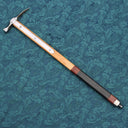
This war hammer features a leather grip and a wooden shaft. A fantastic melee weapon for medieval collectors, perfect for reenactment battles and late-medieval reenactments.


