


Product description
This type of shield is based on originals depicted on the Bayeux Tapestry (1066). The tapestry shows the Norman conquest of England and the Battle of Hastings in 1066. Shields of this type are also illustrated in the Codex Aureus Epternacensis (early 11th century) and the chronicle Liber ad honorem Augusti sive de rebus Siculis (1196). Shields like these were likely introduced by the Normans and, after the First Crusade, were used by many Christian, Byzantine, and some Islamic armies.
The shield provided ideal protection and was used by both cavalry and infantry. During long marches, it could be carried on the back, sometimes upside down. In the second half of the 12th century, these shields were gradually replaced by shields with flat tops. Early examples like this often still feature a shield boss, a tradition inherited from round shields, where the handle was mounted behind the boss. On kite shields, the boss no longer served a practical function but was intended so the shield could also be used as a weapon in battle, allowing the soldier to strike with the boss.
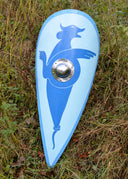
The shield has dark blue edges and a dark blue griffin in the center. The rest of the shield is light blue. The center features a shield boss, which is supplied separately with six nails and can be easily attached to the shield. You can also choose to give the boss a raw, unpolished finish and use historical-style nails for an extra authentic effect.
The back of the shield has three adjustable leather straps, allowing it to be carried on the arm or over the shoulder. The shield is also padded, which softens the impact of blows. It weighs 2.85 kg and is suitable for reenactment.


