


Product description
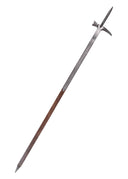
The bec de corbin (French: bec de corbeau, “raven’s beak”) is a poleaxe from the 15th–16th century, related to the war hammer. The weapon resembles the Lucerne hammer and consists of a hammerhead with a spike mounted on a long shaft. Unlike the Lucerne hammer, the “beak” or hook was primarily used rather than the hammer face. The striking surface was often blunt, whereas the Lucerne hammer had multiple points. The beak was sturdier and better suited to penetrate plate armor, mail, or gaps in armor. Some variants did include a multipoint hammer. The spike on top was shorter and thicker than on the Lucerne hammer.
The term bec de corbin can also refer to other war hammers, such as mauls and cavalry picks. The related bec de faucon (“falcon’s beak”) refers to a poleaxe or specifically the hook at the back of it. It was the weapon of choice for foot soldiers and remained popular into the 16th century. Fight manuals such as Le Jeu de la Hache (ca. 1400) and Hans Talhoffer’s Fechtbuch (1467) treat the long hammer and poleaxe as important knightly weapons for combat on foot.
This poleaxe is a replica of several originals used during the English Wars of the Roses. The poleaxe was the ideal weapon for piercing plate armor, making it heavily used in man-to-man combat. This poleaxe features multiple points and comes with a butt cap. When blunted, it is battle-ready.


