
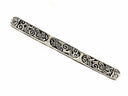

Product description
This piece of jewelry is a replica of a 9th century originally found in Grabung in Latvia. Almost identical jewelry distributors have been found in Gotland and a few in M Väte. Jewelry distributors were used to wear more jewelry. Jewelry stood for wealth, the more jewelry, the richer the wearer.
The richly decorated women's costumes from the Viking time usually contain extensive oval or animal -shaped turtle broches, the design of which could vary depending on the period and region. These fibulas, who were worn in couples, were often connected to bronze chains or colored glass beads.
Very impressive were several rows of different chains that were attached to the turtle broches with graceful jewelry, the jewelry drivers were attached to which several strands and jewelry could be worn under each other.
Dragons were the mythical variant of the snake and were already included in the earliest myths of modern man. With the spread of humans, dragon mythology also migrated all over the world. With many Indo-European peoples, dragons play a prominent role in their mythologies. In Germanic and later Vikingmythology, dragons are seen as all -destructive monsters. At the same time, they symbolize the malignant beast that must be defeated by a hero. These two archetypes - the destroyer and the opponent of the hero - reinforce each other.
Viking chains were made from various materials and served not only as decorations, but also as a status symbol and spiritual object. They were able to contain unique elements and were closely linked to magic, rituals and identity, as evidenced by stories about the Brísing chain and saints such as Genevieve and Bathild. Archaeological finds show that chains could wear both pagan and Christian symbolism and were often associated with ritual specialists, such as the Vǫlur, which they possibly used in Seiðr magic. Research into chain assembly and graves with magical objects suggests that chains played an important role in spiritual and ritual practices within the Viking culture. Viking chains also served not only as a decoration, but also as a status symbol and spiritual object. They were closely linked to magic, rituals and identity, as evidenced by stories about the Brísing chain. Archaeological finds show that chains could wear both pagan and Christian symbolism and were regularly associated with ritual specialists, such as the Vǫlur or Aristocrats.
Product details:
Dimensions: 5.5 x 5.5 cm
Material: silvered bronze
Transport weight (gram): 50 *
This article is made in a limited edition. Every copy is unique. This allows sizes and finish to deviate slightly from each other.
Packed with 100% recycled material
When packing this article we only use 100% recycled plastic and recycled paper/cardboard extracted from FSC certified forests. We immediately reuse a large part of the material without the intervention of recycling process. Recycle the material by separating your waste.
1. Cardboard: separate or reuse paper.
2. Plastic cushions, clothing bags and plastic tape: separate or reuse plastic. Possibly pierce the cushions with a needle for volume reduction.
3. Paper packaging for jewelry and small items: have a plastic inner layer. Remove this, and then separate paper and plastic.