
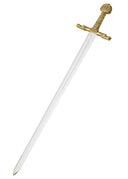

Product description
The Sword of Joyeuse, now housed in the Louvre Museum, is one of history's most legendary weapons. It is traditionally linked to Charlemagne, the renowned King of the Franks. If this sword truly belonged to Charlemagne, who ruled over 1,200 years ago, it would have been used in numerous coronation ceremonies and is steeped in myth and legend, with tales attributing it with magical abilities.The tale begins in 802 AD, when it is said that the sword, named "Joyeuse" (meaning "joyful" in French), was forged by the famous blacksmith Galas. The sword supposedly took three years to complete and was believed to possess extraordinary powers. Its brilliance was said to be so intense that it could outshine the sun and blind the enemies of its wielder. Additionally, any person wielding Joyeuse was thought to be immune to poison. Legend holds that Charlemagne, returning from Spain, came across the sword and claimed it as his own.
The Eleventh Century Song of Roland describes Charlemagne riding into battle clad in magnificent armor with Joyeuse by his side, proclaiming, “Never was there a sword to match it; its colour changed thirty times a day.” Among the sword’s reputed magical properties was its ability to blind enemies in battle with its radiant glow and to protect its owner from all poisons.
One story recounts how Charlemagne once lost Joyeuse and vowed to reward anyone who could return it. A knight found the sword and returned it to the king. Charlemagne then stuck the sword in the ground and declared the surrounding land to belong to the knight from that day forward. This is said to be the origin of the French town of Joyeuse, founded in honor of the legendary sword.
Charlemagne, also known as Carolus Magnus or Charles the Great, was born in 742 and became one of history's greatest leaders. He was the ruler of the Franks and later crowned Emperor of Western Europe, playing a pivotal role in the history of the Holy Roman Empire. His empire was built upon the military strength of the Franks, a confederation of tribes from the Rhineland in Germany. After the fall of the Roman Empire, the Franks filled the power vacuum in Europe. Driven by ambition, and often motivated by the goal of spreading Christianity, they expanded their influence across France, Germany, Italy, and beyond.
As a fierce conqueror, astute politician, and skilled general, Charlemagne shaped an empire whose legacy continues to echo through history, influencing the development of Europe well into the 20th century.
Product details
Product details:
Overall length approx. 97cm
Blade length approx. 80cm
Length of the guard approx. 20cm
Blade width at the guard approx. 43mm
Blade thickness approx. 5mm
Thickness of the blade edge approx. 1mm
Weight approx. 1790 g
Bronze plated hilt, cast from Zamac (zinc alloy).
Blade: 420 stainless steel, 48–52 HRC, etched
Edge: semi-sharp (1 mm) (decorative use only)
Based on a historical original
Shipment weight (g): 2000


