


Product description
This parazonium is based on an original depicted on a relief of a Roman general from the 1st century BC – 1st century AD. Alongside the parazonium, the general carries a musculata with a subarmalis underneath. The parazonium is strongly associated with the Roman Empire but has older roots with the Scythians, who carried it as a symbol of authority. The Persians adopted the acinaces dagger tradition from these nomads, after which the Greeks adopted the parazonium from the Iranians.
This short sword was practical for hoplite warfare, where it could be thrust between shields. Spartans often used short swords instead of longer xiphos, which may also apply to the parazonium. The Romans adopted the weapon from the Greeks, with a scabbard resembling that of the Macedonians, though the grip and pommel were different. In the early Roman army, the parazonium served as a backup weapon, but from the 2nd century BC onward it became primarily a ceremonial attribute for high-ranking officers and emperors. It was often carried under the left arm and symbolized courage and rank, as seen on Trajan’s Column.
In Roman visual culture, the parazonium frequently appears. Mars is depicted with it as a symbol of military power, Virtus as an embodiment of courage, and Roma as a symbol of the strength of the Roman Empire. Emperors and high officers also carry the weapon, sometimes with a pommel shaped like a double-headed eagle, as in a bronze statue fragment from Lucentum.
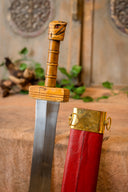
This sword is 57 cm long, with a 40 cm blade that tapers into a leaf shape. The grip is made of bone. The sword weighs 1 kg and comes with a luxury scabbard.


