


Product description
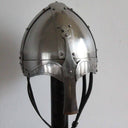
This spangenhelm is of the nasal helmet type. Helmets like this were used throughout Europe from the 9th century onwards and remained in use at least until shortly after 1066, around the time they are depicted on both Norman and Anglo-Saxon warriors in the famous Bayeux Tapestry. Such helmets were worn by the Vikings as well as by other Germanic peoples. From this type of spangenhelm eventually evolved the well-known nasal helmet.
Unlike later nasal helmets, early spangenhelms were originally made of multiple parts connected with spangen. This was a cheaper production method introduced during the Late Roman period. The nasal guard provides protection for the entire face while maintaining an optimal field of vision. An additional advantage was that these spangenhelms could be repaired during campaigns.
This spangenhelm features a conical bowl. The nasal guard is attached to the middle and lower spang. Decorative eyebrows are mounted above the nasal guard, providing extra reinforcement to this vulnerable part of the helmet. The eyebrow motif originates from a Germanic–Roman tradition, in which semi-ritual facial expressions contributed to the identity of the wearer. This tradition can be seen as an expression of the pagan warrior class, which associated warfare with ecstatic fury unleashed on the enemy. Interestingly, in medieval manuscripts, nasal helmets like this are always depicted in combination with a chainmail coif.
The helmet is made of 2 mm thick steel. The four parts are welded together and reinforced with spangen. The 3 mm thick nasal guard, like the eyebrows, is hand-forged. The helmet features a thick, adjustable liner and a chin strap for secure wear.
This helmet is available in sizes M and L. Size M fits a head circumference up to 61 cm and weighs 3.15 kg. Size L fits a head circumference up to 63 cm and weighs 3.3 kg.


