


Product description
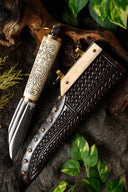
This sax is based on originals produced around the 9th to 11th centuries on the British Isles. This type of sax is mainly found in the British Isles and Ireland, though a few examples were also used in Scandinavia and Germany. Saxes like this were used both as weapons and as cutting tools in daily life, and they may also have played a ritual role in offerings.
As the name suggests, the Viking sax originates from the Viking Age. It is also known as the “Broken Back Seax,” a name derived from the shape of the blade. The grip immediately draws attention; it is made of bone and decorated with a Borre-style motif. The ends of the grip feature brass fittings. The scabbard includes a brass ring for threading a cord through (cord not included).
Dragons were the mythical variant of serpents and appear in the earliest myths of modern humans. As humanity spread, so too did dragon mythology across the world. In many Indo-European cultures, dragons play a prominent role in mythologies. In Germanic and later Viking mythology, dragons were seen as all-destroying monsters, yet at the same time symbolized the evil beast that a hero must defeat. These two archetypes — the destroyer and the adversary of the hero — reinforce one another.


