

Table of Contents
In this blog, we inform you about the different types of chainmail available and for which purposes you can use them. But first, we briefly look at the history of the chainmail shirt. Of course, no blog about the chainmail shirt is complete without mentions of what was worn under the chainmail shirt. We will explore this per period.
What is a chainmail shirt
Chainmail, or simply mail, is a type of armour consisting of small metal rings linked together in a pattern to create a mesh-like structure. This armour was extensively used in military circles from the 3rd century BC.
Chainmail is made of thousands of individual rings woven together. Historically, the rings were tightly riveted with a round or wedge-shaped rivet.
Names
The standard names for European chainmail shirt come from French: greaves are called chausses, a chainmail coif is a mail coif, and gauntlets are called mitons. A collar of mail hanging from a helmet is called a camail or aventail. A mail shirt is called a hauberk if it reaches the knees, and a haubergeon if it reaches halfway down the thigh. We have also used these names as much as possible in our assortment.
What protection does a chainmail shirt offer?
Historically, mail shirts were always riveted. The protection that a chainmail shirt offers depends on the inner diameter of the rings 9mm-6mm. In historical mail shirts, we sometimes see that smaller inner diameter rings were chosen for more vulnerable parts such as the front of the neck. Most mail shirts were made in a weave of 1:4 . This means that 1 ring is connected to 4 other rings. Riveted mail shirts provide protection against cutting weapons, such as swords, knives etc. Additionally, mail shirts offer some degree of protection against thrusts from spears, arrows, etc. But against well-placed heavy thrusts, mail shirts offer less protection. Also against axes and pole- & impact weapons, mail shirts offer less good protection than plate armor. According to a study of skeletons found on the battlefields of Visby on Gotland, the majority of the skeletons showed injuries to less well-protected legs. Although chainmail shirt provided formidable protection, it could be pierced by the conventional weapons of another knight, especially due to technological advancements over time.
Undergarments
The flexibility of chainmail shirt meant that a blow often injured the wearer, potentially resulting in serious bruises or fractures, and it offered poor protection against head trauma. Warriors in chainmail shirt often wore separate helmets over their chainmail coifs for head protection. Also, blunt weapons such as maces and war hammers could injure the wearer through the impact, without penetrating the armour; they usually wore soft protection, such as a gambeson, under the hauberk.

How mobile are you in a chainmail shirt
Mail shirts weigh approximately 7 to 15 kg. If you hold a chainmail shirt for the first time, it is noticeable that it is heavy. But once you wear it, it becomes apparent that it does not restrict your mobility. With a chainmail shirt, you can run with ease. They were also worn on campaigns ‘s at night during sleep. Especially if you fasten the chainmail shirt around the waist with a belt, the chainmail shirt barely restricts your freedom of movement.
History of the chainmail shirt
Mail shirts in antiquity

The oldest known mail shirts have been found in the Celtic chieftain's grave in Horný Jatov in Slovakia and in Ciumești in Romania from the 3rd century BC. But the Etruscans also used variants of mail. It is possible that mail developed from scale armour. Mail is specifically mentioned in the Avesta, the sacred texts of Zoroastrianism, a Persian religion founded in the 5th century BC by the prophet Zoroaster.
There is various evidence of Roman Mail. It is possible that the chainmail shirt was introduced in Rome in the 3rd century BC during the conflicts with the Celts. The lorica hamata was used by both legionaries and auxiliary troops. The first documented use of it occurred during the Roman conquest of Hispania.

The lorica hamata was very popular among the legionaries. Centurions also preferred it. However, they were expensive to produce, and initially, only the wealthiest legionaries could afford a lorica hamata. Later, around the 1st century BC, it became more widely used when generals began to finance their legionaries' equipment. During the early empire, images of emperors in a lorica hamata or lorica squamata (scale armour) were rare. However, in the later empire, such images became more common. In the first century AD, the lorica hamata began to be gradually replaced by the lorica segmentata. Nevertheless, the lorica hamata remained common among legionaries in the second century. In the fourth century, the lorica hamata was reintroduced as the only standard armor.

When we talk about chainmail from antiquity, the name lorica hamata is usually used. Although the Celts and, for example, the Macedonians used the same type of chainmail shirt.

Underclothing
Historians do not agree on what was worn under one's chainmail shirt in Antiquity. It is possible that in Antiquity a thick woolen tunic or padded tunic was worn under the lorica hamata. It is also possible that the subarmalis was worn under the lorica hamata.
Early Medieval Mail Coats
Historians disagree on what exactly the Carolingian mail was. Due to the lack of archaeological finds and reliance on art and literature, some think it was a long, heavy leather coat with metal scale armor, while others believe it was simply a longer, heavier chainmail shirt. Without more evidence, this remains a topic of debate. In the Swedish Valsgärde, Germanic helmets from 610–635 AD have been found with mail.
Viking Mail Coats
In Scandinavia, various fragments and complete mail coats have been found that can be attributed to the Vikings. In the famous grave of Gjermundbu In Haugsbygd, a complete chainmail shirt (haubergeon) was found. The Vikings gave relatively few armors as grave goods, unlike their Germanic ancestors during the Valsgärde period. Possibly, only a small number of Vikings could afford this equipment. In the Hjortspring boat grave, several chainmail shirts were found. There are various Byzantine and Anglo-Saxon records that mention Vikings wearing chainmail shirts. A chainmail shirt is also called a 'byrnie', which is derived from the Old Norse word brynja.
Both the Vikings and other early medieval peoples likely used both the hauberk and haubergeon.
Underwear
There is no evidence that the Vikings wore a gambeson under their chainmail shirt. They possibly wore a thick woolen tunic that may have consisted of multiple layers under their chainmail shirt.

Medieval Chainmail


The first European literary mentions of the word "mail" are found in 12th century Old French and Anglo-Norman, where it was written as maille, maile, male, or other variants. In Middle English, this changed to mailye, maille, maile, male, or meile . The standard names for European chainmail shirt come from French. Historically, mail is called maille and not chainmail. However, the term chainmail is used worldwide. On the Bayeux Tapestry made in honor of the Battle of Hastings in 1066, many Norman knights wear mail hauberks.
In later 12th-14th century manuscripts, knights are often depicted with mail hauberks. In the 13th-century Maciejowski Bible, knights in mail hauberks are clearly visible. Around this time, the Chainmail shirt was part of the standard equipment of the European knighthood.
On the Bayeux Tapestry, the Norman knights appear to wear only mail hauberks with a rider's split in the middle. It is likely that the Normans did not wear separate mail coifs, but the coif and the hauberk formed a whole. There is no evidence that the Normans wore gambesons under their mail hauberks. It is likely they also wore thick woolen tunics, possibly consisting of multiple layers, under their chainmail shirt.
From the 12th century onwards, manuscripts increasingly show the use of separate mail coifs. From this period, we also see that under the mail / hauberk gambesons are worn.
14th-15th century chainmail shirts
From the 2nd half of the 14th century, chainmail shirts were increasingly replaced by plate steel armour components. Around this time, chainmail supplements developed. These chainmail parts were used to protect openings in the armour, but ensured that the wearer did not have to wear a complete chainmail shirt under his armour. Around this time, the small chainmail shirt (haubergeon) was also introduced. This remained in use until the 16th century. The great advantage of this was that it could be easily donned and functioned as an initial armor in case of a direct attack.


Different Types of Mail
It depends on your preferences which type of chainmail shirt suits you best. Various types of mail shirts and components are available in our assortment, ranging from unrivetted mild steel and aluminum to fully riveted 6mm. We will review all the different possibilities with you.
Historical Mail Shirts
Historically, mail was always riveted. Therefore, in this part of the blog, we will discuss all options of riveted mail shirts.
Not every chainmail shirt from history was made in the same way. Therefore, we offer different types of mail shirts with various ring shapes, inner diameters, and different types of rivets.
Flat or round rings?
Unlike modern mail shirts, mail rings were not universally flat. They were also not as round as they are today. The strands of steel were hammered flat and were thus semi-flat. Nowadays, a chainmail shirt could easily cost thousands of euross. Therefore, we offer the option for mail shirts with round or flat rings.
Which Type of Rivets?
From the second half of the 14th century, people began experimenting with making mail shirts (and components) riveted with wedge shaped rivets. In the 15th and 16th centuries, both types of rivets were used.

What type of ring diameter?
Not every chainmail shirt from history is made with the same type of ring diameter. Many, however, are made from rings with an inner diameter of 6 mm. Chainmails with this inner diameter have the advantage of offering better protection against thrusts and are lighter than chainmails made from rings with a larger inner diameter. This type of inner diameter makes the production of the chainmail shirt more labor-intensive. As a result, these chainmails are more expensive. In principle, for reenactment or historical education, chainmails with rings of an inner diameter of 8 or 9 mm are used worldwide.
Mixed riveted chainmails
Historically, not every ring was riveted. Mixed riveted chainmails are made from mail rings that are riveted closed with a rivet and fully closed mail rings. The advantage of this construction is that the chainmail shirt is stronger and cheaper than when each ring is individually riveted closed. There are different variants of mixed riveted chainmails.
Fully Riveted Chainmail
Historically, not every chainmail was made from mixed riveted rings. Therefore, we also offer chainmails where every ring is riveted.
Modern Mail Coats
Not everyone needs an expensive replica of a chainmail shirt. Therefore, various cheaper options have been developed to, for example, improve wearing comfort.
Unrivetted mail coats
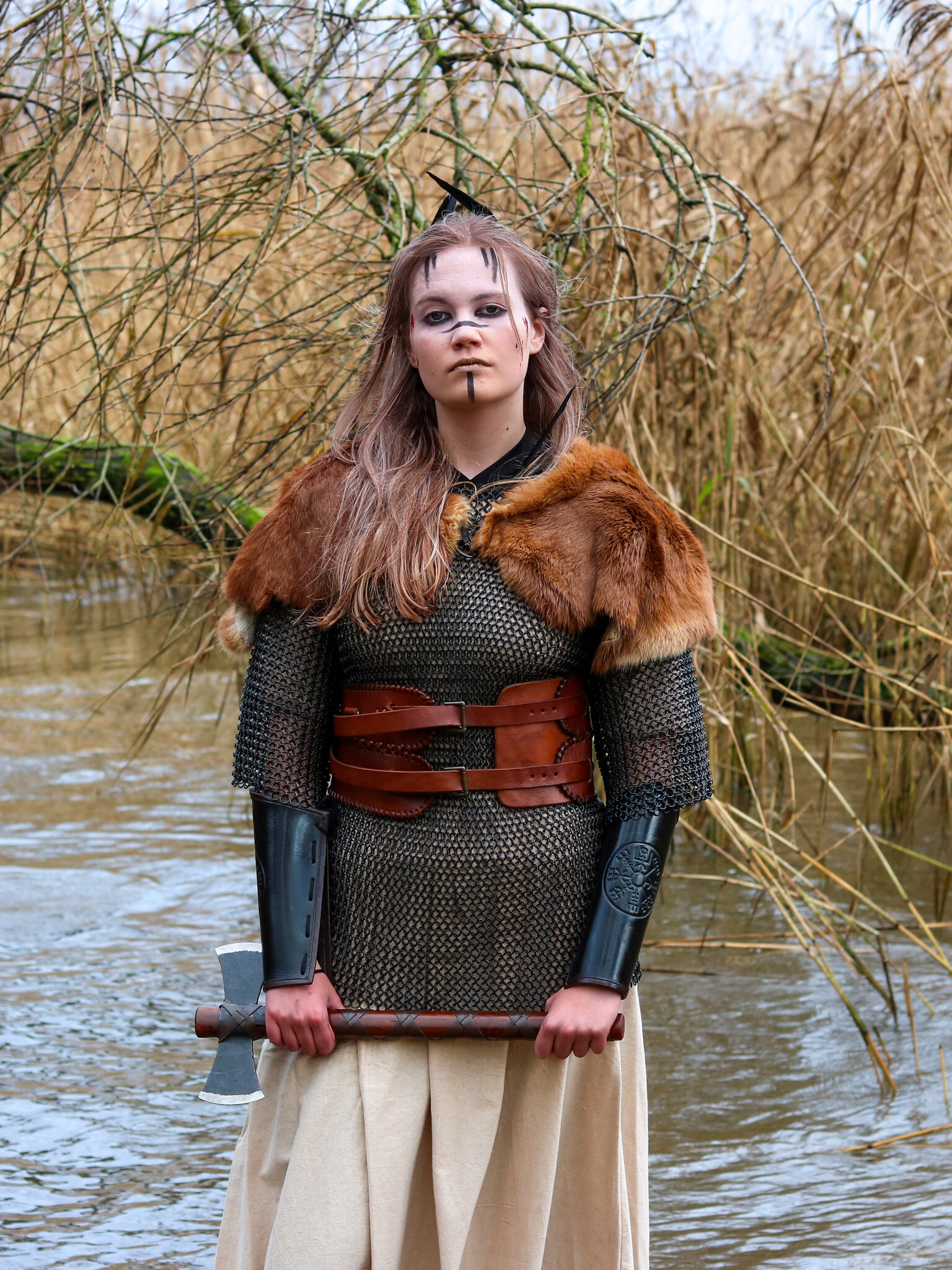
Unrivetted mail coats are much cheaper than riveted mail coats. The reason for this is that there is no need to rivet to make these mail coats. These mail coats are ideal for beginners, for attending festivals, participating in LARP or fantasy where riveted mail is unnecessary.
In our assortment, you will find two different types of unrivetted mail.
Unrivetted mild steel
This is the cheapest option and perfectly wearable all day. However, it does not offer the protection of a chainmail shirt.
Unrivetted spring steel
These chainmail shirts are made from tougher chain rings. They are not riveted but are a cost-effective alternative for beginner reenactment or if you want to create a historically looking ensemble without spending too much money on the chainmail shirt.
Aluminum chainmail shirts
If you want to save weight, for example on a film set or during a LARP, then aluminum chainmail shirts are ideal. These chainmail shirts are made of riveted rings and thus look lifelike like historical originals. However, the weight is sometimes reduced by as much as 1:3.
https://www.celticwebmerchant.com/nl/aluminum-malienkolder-john-geklonken.html
Aluminum mail shirts, rubber rings
As a development of aluminum mail shirts, mail shirts have been developed that are made mixed from aluminum and rubber rings. The rubber rings make the chainmail shirt stretchable and both types of rings make the chainmail shirt even lighter than the aluminum chainmail shirt.
Which type of chainmail shirt is most suitable for you depends on your requirements that the chainmail shirt must meet. Of course, as specialists, we are always available to help you make the right choices.


