


Product description
Chainmail chausses were the standard type of metal leg protection in Europe from the 9th century until the early 14th century. They offered flexible protection against most weapons but were gradually replaced by iron plate armor from the second half of the 13th century. The earliest examples date from the 9th century, such as a chainmail-covered foot in the Kyulevcha catacombs in Bulgaria. Byzantine art depicts calf-length chainmail chausses in Tokali Kilise (10th century) and Karanlik Kilise (11th century). Full chainmail chausses were presumably already in use at the beginning of the 9th century and spread via the Danube or Italy, as can also be seen in the Stuttgart Psalter. One of the most famous depictions in Western Europe appears on the Bayeux Tapestry (1066–1083), where William the Conqueror and other knights are shown wearing them. Around 1200, chainmail chausses were almost standard equipment for knights and men-at-arms.
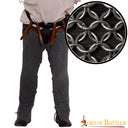
These chain mail chausses are made of unriveted round rings. The rings are made of galvanized mild steel and are woven together in a 4:1 construction. This means that 1 ring is attached to 4 other rings. These chausses can easily be adjusted to size and are approximately 96 cm long. They are attached to the belt.


