

Table of Contents
From Pegasus to Epona and Sleipnir: Horses are widely revered and deified in Indo-European cultures. In this blog, we discuss various examples of Indo-European horse worship.
This story is inextricably linked with the domestication of the horse. Although it is not certain when this took place, it was likely around 4800 BC.
The Proto-Indo-European peoples living on the Pontic-Caspian steppe probably originally kept horses for winter food. Later, they learned how to ride horses and used the animals for pulling carts. From that moment, the horizon of these peoples was significantly broadened.
Read more about this development in this blog.
Around 3000 BC, the Proto-Indo-Europeans migrated from the Pontic-Caspian steppe to Europe. In doing so, they laid the basic for cultures such as the Vikings, Romans, Greeks, and Celts.
Riding horses was a revolutionary development. As a result, the horse acquired its role in mythologies and pagan religions.
Trigger warning
In some cultures, horse worship was associated with zoophilia. It is possible that there was no actual sexual intercourse with the horse, but this is a symbolic mention. Additionally, this blog discusses the sacrificing of horses.
We aim to provide as representative a picture of horse worship as possible, which requires mentioning these aspects. We strongly disassociate from any form of animal abuse.

Proto-Indo-European horse sacrifices
The Samara culture (around 5000 BC) was a culture at the northern edge of the steppe zone from which the speakers of Proto-Indo-European later migrated. There is no evidence that they rode horses, but many objects depicting horses have been found in their graves. Additionally, people were buried with horses; often only the head and feet. It is uncertain whether these horses were already tamed, but they were certainly used for their meat. Horses, like cattle and sheep, were given as grave gifts.
Between 4200 and 4000 BC, new burial traditions emerged in the Suvorovo culture around the Danube Delta. They buried their dead with polished stone maces in the shape of horse heads and beads made from horse teeth. Excavations at Sredni Stog II and Dereivka on the Dnieper showed that a large portion of the animal bones found were from horses, suggesting that horses were at least domesticated and possibly used for riding. Their symbolic and practical value thus increased.
Horses became central sacrificial animals in the religion of the Proto-Indo-Europeans. Royal rituals often revolved around large horse sacrifices, such as the sacrifice of a white horse symbolizing the sun. This sun ritual connected the king with the fertility of the land, with the king seen as the embodiment of the land.
According to the religious scholar Mircea Eliade, the horse sacrifice originally had a cosmic significance, with the horse associated with the sky god *Dyḗus ph₂tḗr and the cosmos. The sacrifice represented a symbolic rebirth and renewal of the world.
In the Maykop culture (3700-300 BC) and the Yamna culture (3300-2600 BC), leaders were sometimes buried with wagons. This was also a status symbol; with the invention of the wheel, people could build wagons and became more mobile. This allowed them to herd their flocks more easily. Like the horse, the wagon was a symbol for the sun.
Vedic Horse Worship
The tradition of burying powerful people with horses and/or wagons was continued by many other Indo-European cultures, including the Celts, but also by the Sintashta culture (2200-1900 BC) from the southern Ural region. In Sintashta graves, such as Sintashta Mogila, large numbers of horses were sacrificed. This culture possibly played a key role in the development of the chariot, with the oldest specimens found in Sintashta graves around 2000 BC. The chariot, like the horse, was a symbol for the sun.
The people of the Sintashta culture likely spoke Proto-Indo-Iranian, a branch of the Indo-European language. Their ancestors had migrated to Europe with the steppe herders and then, as an offshoot of the Corded Ware culture, turned eastward.
From the Ural Mountains, their descendants moved further south and settled in Persia and India. In India, this led to the emergence of the Vedic civilization, the Vedic religion is the basic of modern Hinduism.
The Ashvamedha was a ritual in Vedic India, intended to emphasize the sovereign power of a king and achieve spiritual purification. The ritual, which began in spring, aimed to invoke fertility and prosperity. Central to it was a white stallion, the so-called 'solar horse', which symbolized power and the cosmic order.
The horse was given the freedom to roam for a year, accompanied by the king's guards. It symbolized the annual course of the sun. If the horse entered the territory of another ruler, this was considered a just cause to conquer that land.
After a year, the horse was brought back. After various rituals, the priests sacrificed the horse. The queen spent a night with the dead horse. Afterwards, the meat was prepared and distributed as a sign of prosperity.
Different sources suggest that the queen had intercourse with the horse during this night; or performed other ritual acts. It is unclear whether this actually took place, or if it was a purely symbolic gesture emphasizing the fertility of the land and the kingdom.

Celtic Horse Worship
The white horse of Uffington, located in the United Kingdom , is made in the Late Bronze Age (1000-700 BC). It is a stylized figure of a horse, created by filling deep trenches with white chalk. The exact purpose of the artwork is unclear. It may have been a symbol for the local Celtic tribe. Joshua Pollard suggests that this horse was also a symbol for the sun, as the sun appears to pass the horse during midwinter.
In several sanctuaries in Gaul and the British Isles, horses were buried in their entirety. Some southern British tribes also buried horses and dogs in grain storage pits.
In Northern Italy, a cemetery was found dating from the 3rd to 1st century BC, where several deceased were buried with horses, in the case of a young man some bones, in the case of a middle-aged woman a whole horse and bones of four other horses.
There are two 'mass graves' of horses found in Gaul, in Villedieu-sur-Indre and in Gondole.
The find at Villedieu-sur-Indre consists of 28 complete skeletons of adult stallions. They were lying on their right side, facing south. Nearby, two dogs were also found, facing west. Carbon dating indicates they were buried sometime between 100 BC and 100 AD. This is the period during which the Romans conquered Gaul.
The find in Gondole was right next to the entrance to the oppidum (fortified settlement) of the Averni. Here, 8 men were buried with horses. These men also faced south. Who they were is unclear, they were buried without grave goods and their skeletons show no traces of trauma.
Besides that Celts were sometimes buried with horses, people of high status were also buried with or in wagons or chariots. Examples have been found in Pembrokeshire and Yorkshire on the British Isles, in Waldalgesheim in Germany, La-Gorge-Meillet, and Somme-Bionne in France.
The French archaeologist Patrice Méniel has demonstrated on basic of research into animal bones at various archaeological sites that there is no evidence for the consumption of horses in ritual centers and burial sites in Gaul. However, horses were consumed before the arrival of the Gauls.

The Celtic Horse Goddess Epona
Epona was an important goddess in the Gallo-Roman religion, protector of horses, poniess, donkeys, and mules. She was especially revered as a fertility goddess, often depicted with a patera (sacrificial bowl), a cornucopia and grain ears, and sometimes with foals. She might have guided the souls of the deceased to the afterlife, similar to the figure Rhiannon in the Mabinogion. Her cult spread in the Roman Empire, especially between the 1st and 3rd centuries AD, and was remarkable because she was one of the few Celtic deities also worshipped in Rome itself.
Epona was depicted in various forms: often sitting on a horse, sitting between two horses, or as a horse tamer. In some depictions, she is shown with a foal, emphasizing her role as a fertility goddess. In Roman art, she is also depicted with horses nearby, often with symbols of abundance and fertility.
The veneration of Epona was mentioned in Roman literature, including by the poet Juvenal, and her images have been found in Roman stables and barns.
Rhiannon
The Mabinogion is a collection of stories in Middle Welsh, one of the main sources of this language. Rhiannon is one of the principal figures, possibly the Welsh counterpart of Epona.
In the first branch of the Mabinogion, Rhiannon rides a radiant white horse, and the men of the protagonist Pwyll cannot catch up with her. After a three-day chase, she stops when he asks her to. The son of Rhiannon and Pryderi also has an affinity with horses.
Because the Mabinogion was written down by Christian monks, the pagan meaning of Rhiannon has been lost. She was likely associated with the Underworld and had supernatural power. Proinsias MacCana interprets her as a sovereignty goddess.
Mari Lwyd
The Mari Lwyd, or "Grey Mare," is an ancient Welsh tradition celebrated after Christmas and in January. During this, a group of revelers visits homes and pubs, challenging residents to a playful verbal contest to gain entry. The Mari Lwyd consisted of a horse's skull, often adorned with colorful ribbons and a white sheet. The group, dressed in colorful costumes, included figures like the Leader, the musical Merryman, and comic characters such as Punch and Judy. The ritual begins with a song to request entry, followed by a humorous debate (pwnco) until the residents conceded.
The origin of the Mari Lwyd is unclear, but it is possibly connected to pre-Christian fertility symbolism.
Horse Worship in Ireland
In the 12th century, the Anglo-Norman Gerald of Wales described a horse ritual in Northern Ulster. As a Christian, he was hostile towards it. A white mare was brought before the crowd, after which the king was to have 'intercourse' with the horse. The horse was then sacrificed and cooked. The king climbed into a vat with the soup, parts of which were offered and other parts were eaten by the tribe. This ritual confirmed his kingship.
Rituals to connect the king with the land are more common in Celtic areas, such as through coronation stones.

The October Horse in Roman Religion
The October Horse (Equus October) was a sacrifice made on October 15 to Mars to mark the end of the agricultural and military season. This ritual, possibly also linked to kingship, symbolized the intertwining of agriculture (fertility) and war (authority). The earliest mention of this practice dates back to the 3rd century BC, while the last reference is from the 4th century AD. The sacrifice likely has Etruscan roots.
Horse sacrifices were rare in the Roman tradition, as animals that were also part of their diet were typically sacrificed. The October Horse was offered to chthonic gods, indicating the association of horses with the underworld. This contrasted with the use of horses in other cultures and emphasized the idea of reciprocity: death symbolized new life.
The Ritual
The sacrifice of the October Horse took place during a horse racing festival on the Campus Martius, originally a training ground dedicated to Mars for young Romans. Several two-horse chariots (bigae) participated in the race, with the right-hand horse of the winning team being sacrificed.
The horse was pierced with a spear and then sacrificed. The head was contested as a trophy by two city districts, while the tail was brought to the Regia to sprinkle the sacred hearth of Vesta. The sacrificed animal was not eaten; instead, the entire offering was burned in a so-called holocaust.
Symbolism
The ritual reflected the Roman identity, in which agriculture and military activity were inextricably linked. Mars embodied both war and fertility, and chariots played a symbolic role in Roman rituals, often associated with power and victories. Additionally, chariots can be linked to the Indo-European solar cult, where the sun moves across the sky in a chariot.
The head of the October Horse was considered a powerful symbol of vitality, fertility, and divine power, serving as a valuable trophy. The tail, sometimes seen as a symbol of sexual potency, reinforced the connection with fertility.
Connection with other rituals
The blood of the October Horse possibly played a role in the Parilia, a purification ritual for shepherds. It was presumably used in the composition of the suffimen, a symbolic cleansing mixture that had an important function in various rituals.

Horse Rituals in Ancient Greece
In ancient Greece, the breeding season of horses coincided with the season suitable for seafaring. Possibly because of this, Poseidon was the Greek god of the sea, storms, earthquakes, and horses. He rides in a chariot drawn by sea horses.
Sailors sacrificed horses by drowning them for a safe voyage. In Greece, aristocratic symbols such as horses were replaced by sea horses, fitting the maritime culture, which was later adopted by the Etruscans.
The Greeks sacrificed white horses to Poseidon and the sun to restore fertility and cosmic order.
The Trojan Horse
The Trojan Horse can symbolize the Indo-European origin of the Trojans and Mycenaeans. Francesco Tiboni suggests that the horse was a merchant ship, adorned with a horse prow, as a tribute to Poseidon. The story of the Iliad likely shares an origin with the Vedic story of the Mahabharata, both derived from a Proto-Indo-European tale.
The Iliad mentions a horse sacrifice several times; King Tyndareus, father of Helen, sacrifices a horse to seal a non-aggression pact among his daughter's suitors, and Achilles sacrifices four horses to accompany his friend Patroclus in the Underworld.
The Horse as a Sun Symbol
The winged horse Pegasus was the son of the horse god Poseidon and the Gorgon Medusa. Wherever he set his hooves, springs emerged, possibly a symbol of fertility. Among other tasks, he carried Zeus's thunderbolts.
The symbol of the winged horse was not only present in Greece but was also used by Indo-Persian peoples. A pin-end from Luristan, present-day Iran, from the 8th to 7th century BC, depicts a winged horse. The flanks are decorated with sun wheels.
Helios, the Greek sun god, rides his sun chariot through the sky every day, guiding his fiery horses.
The Black Demeter
A myth from Arcadia, a region in the Peloponnese, tells how Poseidon fell in love with Demeter, who transformed into a mare to escape. Poseidon turned himself into a stallion and raped her. Thus he fathered Arion, a mythical horse that possessed human speech, comparable to the Norse myth of Loki and Sleipnir. Arion became the favorite horse of Heracles.
Demeter withdrew into a cave in Phigaleia, dressed in the black, to purify herself. In Arcadia, she is therefore also called Black Demeter. Her followers erected a statue for her at this cave, and she was depicted with a horse's head and snake hair.
In this tradition, Demeter was not only the goddess of fertility but also the goddess of mourning and death, like her daughter Persephone. In this context, the horse was also a symbol of death.
Hades, god of the underworld, is also associated with horses, as he rides in a chariot drawn by four horses.
The Scythians
The Scythians were an Iron Age people of the steppes, descended from the Sintashta culture. In their nomadic society, the horse played an essential role, and the horse is frequently depicted on art objects.
The only written source about Scythian religion is the Greek historian Herodotus. According to him, the Scythians sacrificed horses as part of royal funeral rituals. The Scythian equivalent to Ares was not only the god of war but also of kingship and horses.
Archaeological evidence confirms the horse sacrifice as a funeral ritual. In addition, an entire retinue was buried with kings, including a concubine, a cupbearer, a cook, a messenger, and many valuable possessions.
In graves from the 3rd century BC, depictions have been found of a sun god in a chariot, drawn by two or four horses. These may be depictions of Gaiϑāsūra, whom Herodotus equates to the Greek sun god Apollo.

Germanic & Old Norse Horse Worship
Scandinavian Bronze Age
In Bronze Age-Scandinavia, horses are often depicted on petroglyphs, such as on the Villfarastenen, Orstaristningen, and the royal grave of Kivik. On the stones of the royal grave, horses and chariots are depicted, with the wheels of the chariots forming the sun cross. A horse tooth was also found in the grave.
The Bronze Age grave of Sagahögen (1500-1200 BC) contained 42 decorated stones, 75% of which depicted horses. On one of these images, a warrior is engaged in intercourse with the horse.
An archaeological find from Gallemose, Denmark (ca. 2000 BC), shows fragments of a chariot as old as those in the Sintashta graves.
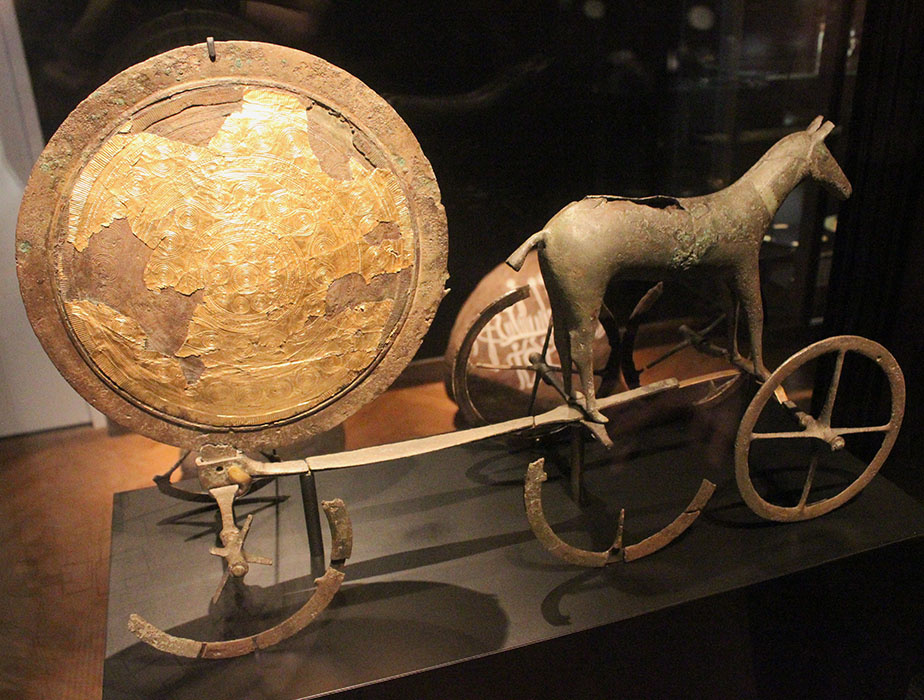
In the mythology of Indo-European peoples, the sun is often represented as a radiant wheel, drawn by a horse. A well-known example is the Trundholm sun chariot (1500-1300 BC), which was not unique. In a burial mound in Jægersborg Hegn, Denmark, fragments of a similar sun chariot have been found.
Sun Horses
The horses Árvakr and Alsviðr draw the sun, or the chariot of the goddess Sól, across the sky. Sól is the sister of Máni, the moon. Like Sól, Dagr (day) and Nótt (night) are drawn across the sky by two horses, Skinfaxi and Hrímfaxi.
On stone art from Gotland predating the Viking Age, the sun is often depicted as a spoked wheel, often in combination with horses.
For the Vikings, the death and rebirth of the sun were of great importance. In their mythology, the sun was devoured by Fenrir.

Freyr
Freyr was the Scandinavian god of fertility and was associated with horses. His priests kept sacred horses in his sanctuary in Trondheim, Norway.
The main character of Hrafnkel's saga is a priest of Freyr, who dedicates a horse to the god and kills a boy when he rides the horse. The taboo of riding certain horses is more common in Germanic sources.
Funerals
It was very common for powerful Vikings to be buried with one or more horses. In Norway, men were particularly buried with horses, but strangely enough, most graves in Iceland are of women.
Probably, the horse was the symbol for the god Freyr, a status symbol to accompany the deceased to the other world. The meaning of these rituals changed over the centuries.
Ship burials from the Germanic Vendel period often included horse sacrifices. A 2014 study shows that horses were present in 31% of aristocratic Vendel graves and in 17% of Viking graves. Horse burials also occurred among the Lombards, Anglo-Saxons, and other Germanic peoples.
In the Oseberg ship, two female skeletons from the early 9th century AD were found. They were buried with at least fifteen horses, four dogs, and an ox. The horses were beheaded.
A similar kind of funeral ritual is described by Ahmad ibn Fadlan (10th century). He describes how two horses galloped until they sweated. Then they were sacrificed and their bodies were placed on a ship with the deceased leader. A slave girl of the leader went around all the present tents to have intercourse with the present men, before she was sacrificed and placed on the ship. She traveled with her leader to Valhalla.
This practice shows many similarities with the Scythian royal funeral ritual, and archaeological evidence supports this.
Offerings
A clear example of horse offerings in the Viking Age comes from the saga of Hakon the Good, in which a Yule feast in Trondheim is described. During this feast, the king had to participate in the offerings, with the horse being the main offering. Hakon, a Christian king, refused to eat horse meat, which led to conflict with his people, who would only recognize him if he had eaten the meat. The blood of the sacrificed animals was collected in bowls and sprinkled over the hall, the gods, and the participants. The meat was eaten.
In the Hervarar saga, a horse offering in Uppsala is described, where the horse was cut into pieces and eaten by the people. The blood was sprinkled over the sacred tree Sprinkled from Uppsala. Eating horse meat was very common in Scandinavia. With the rise of Christianity, it gradually became taboo.
The sprinkling of blood is a ritual also found in the Roman Equus October, the mystery cult of Mithras, and in the Greek Odyssey. This symbolizes the connection between the dead and the living. By sprinkling the blood, the people shared in the positive power and fertility of the horse, the land, and the king.
Adam of Bremen (1072) mentions an Old Norse ritual where nine sacrifices were made to Odin, who himself had hung on Yggdrasil for nine days and nights. The sacrifice consisted of nine of each living being, such as nine dogs, horses, and even humans. After the offering, they were hung on a tree. This ritual took place every nine years. A similar ritual is mentioned on the Stentoften runestone from 600 AD.
Predictions
Tacitus reports that the Germans predicted the future not only by studying the flight of birds but also by using a white mare.
These were kept in sacred groves, where they did not have to work or be ridden. They pulled a sacred wagon in which someone could sit. The king or priest observed the behavior of the mare. Adam of Bremen described the same ritual, in which not only the king or priest but also other social classes used the mare.
Hestavíg
Hestavíg was a popular form of entertainment during the Viking Age in the Icelandic Commonwealth (930–1262). It possibly originated in Norway.
The ritual likely consisted of bloody fights between two stallions, encouraged by their owners. The aim of these fights was to select the best breeding animals and was of cultural significance. It led to tension and excitement, but also to verbal and physical confrontations among the spectators. The outcome could influence social and political relationships between goði (local leaders) and bóndi (farmers), as shown in the Norwegian sagas.
The fights took place on neutral ground and provided an opportunity to strengthen friendships or settle conflicts. It was also a chance for young people to meet and start romantic relationships. However, rivalries sometimes escalated into violent conflicts, as described in the Njáls saga and the Víga-Glúms saga.
Sleipnir, the horse of Odin
Sleipnir, the eight-legged horse from Norse mythology, is ridden by the god Odin. It is the offspring of Loki and the horse Svaðilfari. As the best of all horses, Sleipnir is praised in prominent Old Norse texts such as the Poetic Edda and the Prose Edda. In these sources, it is described as Odin's faithful steed, with the ability to travel between worlds, including the realm of Hel.
The origin of Sleipnir is linked to a myth in which Loki transforms himself into a mare and mates with Svaðilfari, resulting in the birth of this remarkable creature. Sleipnir is also mentioned in other Norse sagas, such as the Hervarar saga ok Heiðreks and the Völsunga saga, and appears on stone monuments from the Viking Age.
Some researchers see in Sleipnir's eight legs and its role as a traveler between worlds a connection to shamanistic traditions. In Icelandic folklore, it is even claimed that Sleipnir is responsible for the creation of the Ásbyrgi canyon. The eight-legged horse also has a lasting influence on modern culture, where it appears in art, literature, and as an inspiration for the names of ships and other objects.
Conclusion
The horse was an important symbol in Indo-European cultures. It symbolized the sun, the land, fertility, kingship, and the afterlife.
As a sun symbol, the horse drew the sun across the sky each day. Because the sun indicated the size of the seasons, the horse thereby became a symbol of fertility and the land.
This made the horse closely associated with kingship. Royal rituals involving horses aimed to emphasize the king's sovereignty and ensure the fertility and prosperity of the land and subjects.
To emphasize their status, high-ranking deceased individuals were often buried with one or more horses, or with or in a wagon. As such, the horse was also a symbol of death.


